

Agrochemicals
Current location:Home > Agrochemicals
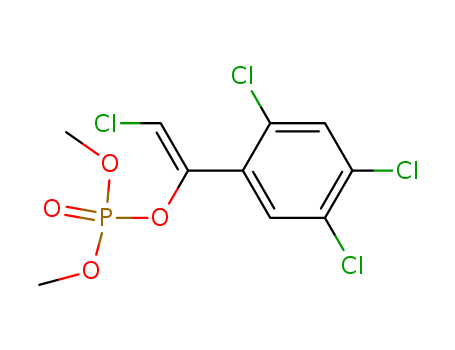
Excellent chemical plant bulk supply Tetrachlorvinphos 22248-79-9
- Molecular Formula: C10H9Cl4O4P
- Molecular Weight: 365.965
- Appearance/Colour: Colorless crystals or white powder.
- Vapor Pressure: 3.14E-06mmHg at 25°C
- Melting Point: 97-98 °C(lit.)
- Refractive Index: 1.553
- Boiling Point: 399.5 °C at 760 mmHg
- Flash Point: 302.8 °C
- PSA: 54.57000
- Density: 1.52 g/cm3
- LogP: 5.60150
Tetrachlorvinphos(Cas 22248-79-9) Usage
|
Hazard |
Cholinesterase inhibitor. Questionable carcinogen. |
|
Carcinogenicity |
When rats were given diets with 0, 4250, or 8500 ppm tetrachlorvinphos for 80 weeks, both males and females had a high incidence of thyroid C-cell hyperplasia, and females had increased incidences of adrenal cortical adenomas and thyroid C-cell adenomas . |
|
Environmental Fate |
Tetrachlorvinphos is nonpersistent in the environment. The primary route of dissipation is through biotic degradation. Based on its use pattern, risks of contamination of groundwater or surface water by tetrachlorvinphos are minimal. |
|
Metabolic pathway |
The chemical structure of tetrachlorvinphos is very close to that of chlorfenvinphos and the routes of metabolic breakdown have been shown to be very similar. Technical tetrachlorvinphos is usually >95% Z-isomer, unlike chlorfenvinphos which is an E/Z mixture. As with chlorfenvinphos, the major routes of detoxification are by dealkylation and hydrolysis to yield desmethyltetrachlorvinphos and 2,2’,4’,5’- tetrachloroacetophenone plus dimethyl phosphate, respectively. Further metabolism of the chloroacetophenone moiety then leads, via reduction or hydrolysis and glutathione-dependent displacement of the side chain chlorine substituent, to the formation of 1-(2,4,5-trichlophenyl) ethane-l,Z-diol and 1-(2,4,5-trichlorophenyl)ethan-l-owl hich are conjugated with glucose or glucuronic acid to afford the ultimate metabolites. Oxidation of the β carbon atom to give 2,4,5-trichloromandelic acid followed by decarboxylation leads to the formation of 2,4,5-trichlorobenzoic acid which is conjugated with glycine in some mammals as the final metabolite. The metabolic routes were summarised by Beynon et al. (1973). |
|
Degradation |
Tetrachlorvinphos is hydrolysed slowly in neutral, acidic and slightly alkaline aqueous solutions but hydrolysed rapidly in strongly alkaline solutions to metabolites 3 and 5 (PM). Dureja et al. (1987) reported the photochemical degradation of tetrachlorvinphos in water, ethanol, ether and hexane irradiated with a xenon lamp. In polar solvents, the main product was desmethyltetrachlorvinphos (2), whereas in non-polar solvents such as hexane the reaction yielded dimethyl phosphate (3), 2,4,5-trichloroacet ophenone (4) and 2,2’,4’,5’-tetrachloroacetophenone (5). Interconversion of the Z- and Ε-isomers has been observed on leaves (Beynon and Wright, 1969). These pathways are shown in Scheme 1. |
|
Toxicity evaluation |
Acute oral LD50 for rats: 4,000-5,000 mg/kg |
InChI:InChI=1/C10H9Cl4O4P/c1-16-19(15,17-2)18-10(5-11)6-3-8(13)9(14)4-7(6)12/h3-5H,1-2H3/b10-5+
22248-79-9 Relevant articles
Macrocyclic plant acaricides
-
, (2008/06/13)
Compounds of the formula I STR1 in which...
Insecticidal composition for agricultural and horticultural use
-
, (2008/06/13)
A synergistic insecticidal composition c...
22248-79-9 Process route

-

-
22248-79-9
tetrachlorvinphos
Conditions
| Conditions | Yield |
|---|---|
|
|
|
|
|
RELATED PRODUCTS
WANT TO
PURCHASE